- ISO 9001:2015 Certified Company
- +91-9672985402
- info@vasundharamicron.com

Sustainability & Soapstone Mining in India: What Responsible Suppliers Do

Why Plastic grade talc is a Game Changer for Polypropylene Manufacturing
December 8, 2025
How Responsible Talc Powder Manufacturers in India Reduce Environmental Impact
January 12, 2026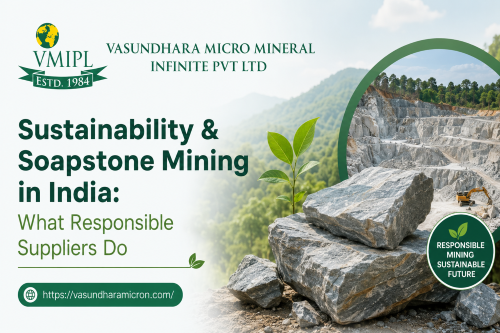
The Environmental Reality Behind Soapstone Extraction in India
In parts of India where steatite extraction occurs, the problems are painfully practical: dust pollution fouls village air, runoff threatens drinking wells, and land subsidence follows careless quarrying in districts such as Bageshwar. Miners and local communities feel the effects directly, and plant operators face shutdown risks when environmental limits are exceeded. A soapstone powder supplier in India that takes responsibility shows how extraction can continue without jeopardizing lives or livelihoods. They adopt measured remediation, monitor groundwater and air quality, and fund local reclamation so livelihoods can recover and coexist with industry. Year-round oversight.
Soapstone and Steatite are produced in India from Mines that extract talc powder and other minerals such as Clay, for use in constructing ceramics, Paints, Plastics and Pharmaceutical Industries in India and abroad. There have been increases in resource recovery due to the growth of these Industries; however, improper overburden management, resulting from and impacting poorly in the economics of the operations, will result in the extraction of fine particulates, as well as the risk of destabilizing the slope. Manufacturers, as well as Procurement Departments, now pay closer attention to the Particle Size Distribution characteristics, Beneficiation Techniques, and the Compliance Records of their Suppliers, in order to reduce process variability and protect Workers, Ground Water, and the long-term viability of a Site. Consequently, the Industry must respond to the Market Demand while also abiding by all Environmental Regulations as well as ensuring the long term Viability of the Site.
How Responsible Suppliers Reduce Environmental and Business Risk
What responsible suppliers actually do is a blend of engineering controls, documented systems, and community engagement that together reduce environmental footprint and business risk. Traceability, product batch-testing, and measurement of ongoing improvements are part of ISO 9001:2015 certified quality management systems and can be used as part of the review process during supplier qualification. Also incorporated into waste management/dust control are enclosed conveyor systems (used for transporting waste), baghouse systems (used for controlling and managing fugitive dust emissions), wet suppression methods, targeted vacuum cleaning methods, and the proper use of settled tailings. All of these methods help to mitigate airborne particles and contamination of land.
Water conservation measures are being implemented in the form of process water recycling, closed-loop systems, and the proper disposal of effluents (wastewater). All of these measures are done in compliance with local laws/regulations and to avoid excessive withdrawals from aquifers.
Mining practices that reduce land subsidence and slope degradation employ staged extraction, controlled blasting limits where used, and planned backfilling of overburden to preserve topography. Community engagement and transparent operations mean timely grievance mechanisms, local hiring, and visible environmental monitoring data that build social license. Isn't it reasonable to ask whether suppliers invest in R&D and pilot beneficiation trials that improve particle control, reduce contaminants, and lower total environmental footprint measurably? As a soapstone powder supplier in India, firms that demonstrate these practices help downstream manufacturers in ceramics, paints, plastics and pharmaceutical processing meet environmental compliance and reduce operational interruptions while supplying consistent talc powder and magnesium silicate feedstock reliably.
Vasundhara Micron’s Long-Term Commitment to Responsible Mineral Sourcing
Vasundhara Micron brings practical proof to these practices through 66 years of continuous operations since 1955. Part of the Nalwaya Group and headquartered in Udaipur, the firm is ISO 9001:2015 certified and maintains documented QA/QC with traceable batch certificates for every shipment. They offer multiple soapstone grades—5µm, 10µm, and 20µm talc powder—sized for specific process windows, and they study particle size distribution and chemistry in-house to meet client specifications.
State-of-the-art milling, classification, and beneficiation equipment is supported by an R&D lab focused on contamination control and energy efficiency. Vasundhara Micron serves paints, ceramics, plastics, pharmaceuticals and cosmetics sectors and exports to the Americas, Europe, Middle East and Africa as a trusted soapstone powder supplier in India. Clients appreciate documented environmental compliance, ready technical dossiers, customized particle sizing, and on-site support for process trials — tangible aids that reduce downtime, improve formulation stability, and lower lifecycle costs for manufacturers and transparency.
Choosing a Supplier That Supports Both Production and Sustainability
When you choose a supplier that prioritizes sustainability, you'll reduce regulatory risk and improve product consistency. Visit Vasundhara Micron to explore our full product range and compliance documents. Discover how our premium soapstone powder can enhance your production. Contact their technical team for sample trials, bespoke sizing, and environmental reports today.