- ISO 9001:2015 Certified Company
- +91-9672985402
- info@vasundharamicron.com

Calcite for ceramic glazes and tiles

Why Textile and Rubber Manufacturers Are Switching to Dolomite Lumps
September 9, 2026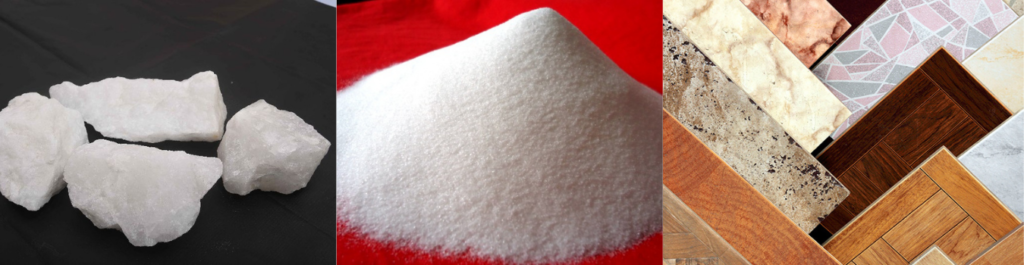
Calcite is calcium carbonate, the same mineral in limestone and marble. In a kiln, it splits into calcium oxide and carbon dioxide, and the oxide is what helps a glaze melt and a tile body harden. Ceramic units that are bought from calcite powder manufacturers in India usually end up arguing about particle size and whiteness. They're right to, because a small shift in either one shows up on the finished tile.
Calcite for ceramic glazes and tiles from calcite powder manufacturers in India
Tile production runs on thin margins and tight schedules. A lot of plants lean toward calcite powder manufacturers in India for a boring reason: shipping is shorter and someone answers the phone. A glaze line can't sit idle for three weeks because a container got stuck.
Local supply has another perk that people undersell. When a glaze starts crawling or a body shows pinholes, you can call the people who made the powder and trace the problem to a lot number. Try that with an overseas trader.
How calcite behaves in a glaze
Flux is the calcite that is part of glaze, which helps in lowering the melting temperature of the surrounding silica and alumina. An insufficient amount of flux results in the roughness of the surface, while an excessive quantity of flux may lead to running, bubbling, or opacity of the glaze.
Whiteness is the other thing buyers check. Iron in the powder can tint a white glaze yellow or grey, which is a headache on sanitaryware and pale wall tiles. Low iron ceramic grade calcite avoids that.
Calcite powder manufacturers in India and the particle size problem
Any decent first conversation with calcite powder manufacturers in India should start with particle size distribution. Fine, even grains mix into a slip properly, melt on schedule and leave a clean surface. Coarse or uneven powder gives you specks and patchy results that take forever to diagnose.
Micronised calcite also settles more slowly, which helps with spraying and dipping. Operators notice that. The glaze behaves on Monday the way it did on Friday.
Where calcite fits in a tile body
Glazes get the attention, but bodies use calcite too. In wall tiles especially, calcium carbonate helps build a porous, stable body and holds shrinkage down during firing.
Take into consideration losses on ignition. Calcite loses about 44% of its weight as carbon dioxide in the kiln, so this must be accounted for in the recipe. Variability in powder composition from one lot to another causes changes in the amount of gas released, and this is one common source of cracking and warping.
Why choose Vasundhara Micron among calcite powder manufacturers in India
If you are just comparing calcite powder suppliers in India based on their prices, you are missing the point. Don’t buy blindly on prices; always ask for batch records too. The price list is not very helpful in knowing what the final product would be like. At Vasundhara Micron, we grind calcite to the required particle size. We check the whiteness and calcium carbonate content before dispatching the product. We take care to keep the batches uniform. We manufacture calcite in grades and packing as per the customer’s requirement. Let us know your firing temperature and we will help you with the right grade.
Before you place the first order
Although Calcite appears to be a dull raw material, it messes up a batch. However, it influences the features of the melt, i.e., its color, the extent of its shrinkage, and appearance. If the right parameters in terms of particle size, whiteness, purity, and homogeneity of batches are known, the search for Calcite powder suppliers in India will become much less complicated. If you have proper information on this matter, there will be no problems. If you are looking for more recommendations concerning your recipes, you have to contact the specialists at Vasundhara Micron.