- ISO 9001:2015 Certified Company
- +91-9672985402
- info@vasundharamicron.com

How Responsible Talc Powder Manufacturers in India Reduce Environmental Impact
Sustainability & Soapstone Mining in India: What Responsible Suppliers Do
January 7, 2026
Mesh Size Matters: Complete Guide to Selecting Particle Size for Soapstone Powder Applications
February 2, 2026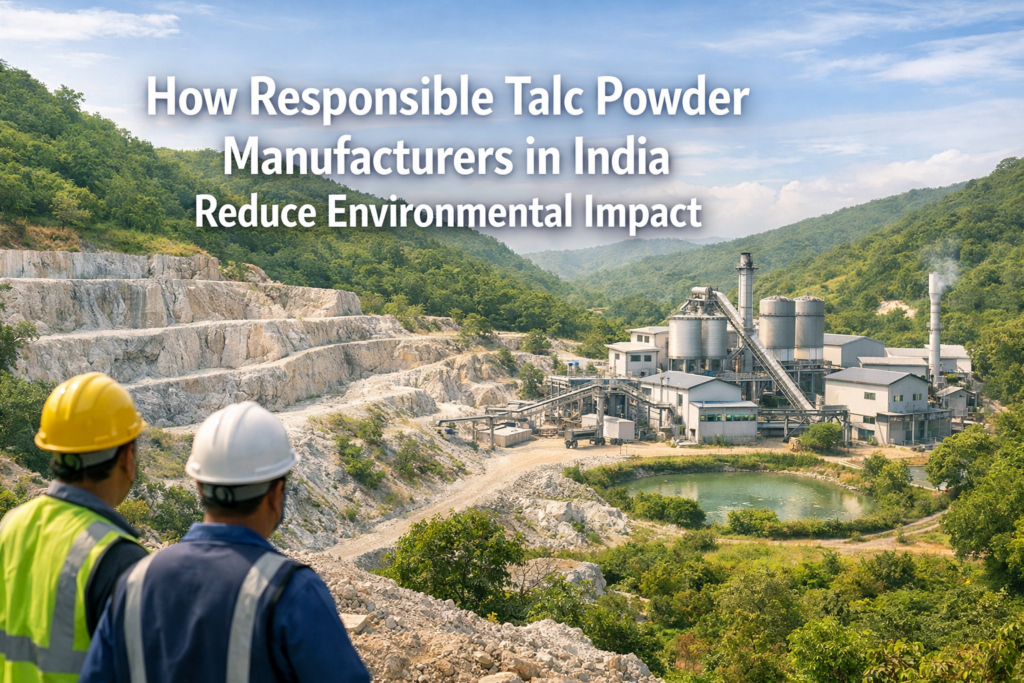
India dominates talc supply, but mining has environmental costs. Picture a quarry where selective excavation replaces clear-cutting; that's Vasundhara Micron's approach. Here's the thing that Talc Powder Manufacturers in India must balance production for plastics, paints, cosmetics, paper and rubber with stewardship. Based in Udaipur, their mines produce fine micron talc with 80–99% whiteness and high MgO >28%; low FeO/Al2O3 <1%, CaO <3%. I've seen first and how traceable sourcing builds buyer confidence and lowers overall footprint.
Sustainable Mining Practices by Top Talc Powder Manufacturers in India
Selective excavation, erosion control and reforestation are pillars of sustainable talc mining. Think about it this way: instead of stripping whole slopes, responsible talc suppliers India use phased extraction, contour benches, silt traps and bio-retention swales to protect downstream water. Roads and haul routes are engineered to limit sediment flow. Replanted native species and progressive land restoration sometimes called "green thumbs in mining" return habitat fast. What sets leaders apart is traceable supply chains and documented rehabilitation plans so industrial buyers can verify environmental claims before they commit.
Advanced Processing for Eco-Friendly Talc Powder Production
Dust suppression systems, closed-loop milling and energy-efficient grinding enable eco-friendly talc powder production. Micronizing talc to 5–100 microns with consistent 50–1250 mesh distribution demands precision; Vasundhara Micron talc uses modern classifiers and baghouse filtration so product quality (80–99% whiteness, MgO >28%) meets cosmetics and specialty plastics specs while keeping particulate off site. Water reuse in wet classification and low-energy air classifiers shrink freshwater demand. For B2B buyers in paints or paper, this means consistent, high-purity feedstock with documented reductions in emissions and water use.
Waste Reduction and Recycling in Talc Manufacturing
Zero-waste goals are practical when you redesign material flows. Think of returned fines becoming fillers for cement blends or non-critical rubber compounding. Washwater solids can be thickened and reused or sold as industrial mineral blends. Vasundhara Micron practices waste minimization through process audits and continuous improvement, turning scrap into feedstock and cutting disposal costs. I've seen plants reduce landfill output dramatically just by reassigning streams and tracking yields with KPI dashboards.
Vasundhara Micron: Pioneering Responsible Talc in India
Vasundhara Micron talc blends product excellence with responsible practices. Their soapstone variants suit paints, cosmetics, food-contact paper and rubber; their fine micron talc (5–100 microns; 50–1250 mesh) offers high MgO (>28%) and whiteness up to 99% with contaminants FeO/Al2O3 <1% and CaO <3%. Based in Udaipur, their mines emphasize ethical sourcing, water recycling, land restoration and low-impact technologies. What sets them apart is traceability and client transparency: certifications, material dossiers and verifiable mine data help compounders and formulators reduce supply-chain risk while meeting sustainability targets.
Partner with Vasundhara Micron for sustainable, traceable talc solutions contact vasundharamicron.com. We commit to long-term partnerships across plastics, paints, cosmetics, paper and rubber, offering formulation support and reliable, certified supply chains with transparent pricing. Indeed.