- ISO 9001:2015 Certified Company
- +91-9672985402
- info@vasundharamicron.com

Why Manufacturers Prefer Long-Term Partnerships with Reliable Calcite Powder Suppliers

Why Inconsistent Talc Powder Quality Is Hurting Your Production Efficiency
May 11, 2026
Why Rajasthan Dolomite Lumps Are Preferred by Exporters Over Other Indian States
June 8, 2026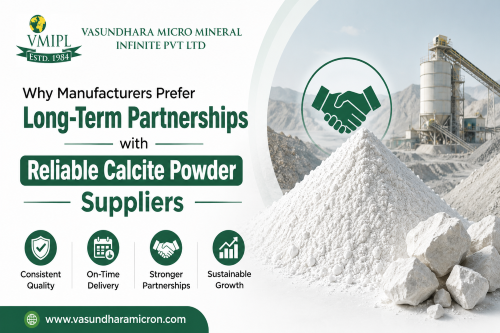
Nobody talks about this enough: switching raw material suppliers is expensive, even when the switch looks free on paper. You test the new material. You adjust formulations. You run smaller batches to be safe. Most businesses that rely on a trusted calcite powder manufacturer understand this reality better than anyone because they have lived through the cost of getting it wrong. You discover three months later that the brightness is slightly off and now your paint client is asking questions. That whole process costs real money. Why break something that actually works?
What Makes a Calcite Powder Manufacturer Worth Staying With
It's not the price. Well, price matters but it's not what makes you stay.
What actually makes you stay is when a supplier calls you before you notice the problem. When they already know your particle size spec without you repeating it every order. When their technical team picks up the phone instead of routing you through three different emails. That's the thing that's hard to put in a purchase order but you feel it immediately when it's gone.
For manufacturers in paints, rubber, PVC, or paper, calcite isn't a background ingredient. The whiteness, the oil absorption, the coating behavior these directly shape how the finished product looks and performs. Get the raw material wrong and you're not just fixing a batch. You're explaining yourself to a customer.
Consistency in Quality Builds the Foundation of Long-Term Supply Agreements
Here's what actually happens when you deal with an inconsistent calcite supplier: your production team starts quietly compensating. They tweak the mix a little here, adjust the dispersion time there. Nobody files a formal complaint. It just becomes part of the process of this low-level friction that everyone absorbs without anyone tracking the true cost.
Manufacturers who've built long-term supply agreements with reliable calcite powder manufacturers don't have that problem. Not because everything is perfect, but because when something is off, it gets flagged and fixed fast. The supplier knows your specs, knows your process, and has enough skin in the game to care about the outcome.
How Reliable Calcite Suppliers Support Better Production Planning
Unpredictable lead times are genuinely disruptive. Most manufacturers handle it by carrying more safety stock than they should which ties up working capital and creates storage headaches. The logic makes sense until you do the math.
A supplier you've worked with long enough will tell you when there's a capacity crunch coming. They'll communicate about sourcing delays before your delivery window closes. That information lets you plan. And planning, in a production environment, is not a minor thing.
Why Vasundhara Micron Earns Repeat Business from Manufacturers
Vasundhara Micron doesn't lead with marketing language. Their pitch is pretty simple: the material quality is controlled, the grades cover a wide range of industrial applications, and the people behind the orders are reachable.
They produce calcite and calcium carbonate suited for paints, adhesives, PVC compounding, rubber, and more. Particle size, brightness, and moisture are monitored consistently not occasionally. For clients who've spent time managing erratic raw material quality elsewhere, that kind of operational steadiness is genuinely refreshing. The repeat business speaks for itself.
The Supplier Decision That Pays Off for Years
Long-term doesn't mean locked in. It means you've done the hard work of finding someone who actually fits your process and you're smart enough not to walk away from that for a marginal cost saving. The manufacturers who keep rotating vendors looking for the lowest quote usually end up paying for it somewhere else: quality issues, delays, formulation drift, staff time spent managing problems that shouldn't exist. Find a supplier who knows your business. Then let them do their job.