- ISO 9001:2015 Certified Company
- +91-9672985402
- info@vasundharamicron.com

Why Vietnam, Indonesia, and Mexico Can’t Get Enough Indian Talc Powder

How Udaipur Became India’s Soapstone Powder Capital: Supply Chain Advantages
April 6, 2026
Why ISO 9001 Certification Is the First Thing to Check Before Buying Talc Powder
May 4, 2026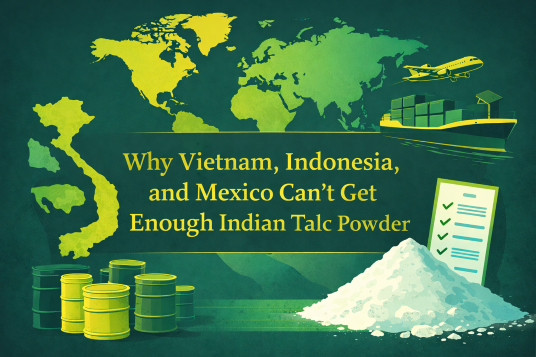
Something has been shifting quietly in the global talc trade. Countries that barely showed up on export records a few years ago are now ordering regularly and three keep appearing on the list: Vietnam, Indonesia, and Mexico. The reasons vary by country, but one thread runs through all of them. Finding a reliable talc powder manufacturer in India that ships consistent quality without drama at this price level is harder than it sounds. Vasundhara Micron has been in enough of these conversations to know what buyers are actually dealing with. They come in asking tighter questions than before. They already know what grade they need. And when the material works, they come back. That's the part that matters.
Why These Three Countries Are Buying More Indian Talc
Each of these three markets has its own story, but they share one thing: factories that need talc and can't afford to keep switching suppliers every few months.
Vietnam's manufacturing sector has grown faster than most people outside the region realize. Plastic goods, coatings, packaging production lines there run tight, and one bad batch of talc can hold things up for days. Buyers aren't chasing the cheapest quote anymore. They've been burned by that. Now they want the supplier who shows up the same way every shipment.
Indonesia is a bit different. The rubber and ceramics industries there have been running on imported talc for a while, and buyers have gotten specific about what they want. Rajasthan-origin material keeps coming up because the brightness and purity levels hold up in ways that alternatives local or otherwise often don't. When a factory settles on a source that actually works, they tend to stay there.
Mexico is probably the most demanding of the three. A lot of Mexican manufacturers are feeding supply chains that run into the U.S. or Europe, which means their buyers set the quality bar not them. They need talc that's already been tested and documented, not something they have to spend two weeks qualifying on their own.
What Makes Indian Talc Stand Out
Rajasthan has some of the better talc deposits in the world not just in terms of size, but in what comes out of the ground. The natural whiteness is high, contamination is low, and that combination is hard to replicate in processing alone. For cosmetics, pharmaceuticals, and food-grade packaging, where even trace impurities cause rejections downstream, ore quality at the source genuinely matters.
Processing has caught up too. Ultra-fine and surface-treated grades that Indian producers couldn't reliably offer ten years ago are now fairly standard. Some buyers who used to source from European suppliers have moved to India not because it's cheaper though it usually is but because lead times are better and the material clears their specs.
That price-vs-quality balance is worth being honest about. It's not that Indian talc wins on cost alone. It's that when buyers who've tested multiple sources sit down and compare, Indian material from a serious supplier holds its own on performance and comes in at a price that makes the math easier.
What Buyers from These Regions Actually Ask For
The inquiry emails from Vietnam, Indonesia, and Mexico have gotten more specific over the years. It used to be just grade and quantity. Now it's particle size distribution curves, brightness readings, moisture limits, acid solubility, heavy metal caps all in the first message.
That's not a complaint. It means these buyers know their process. They're not experimenting with talc; they're sourcing for a production line that's already running, and they need a supplier who can match what that line requires.
Mexico throws in paperwork that some Indian exporters aren't ready for. Safety data sheets formatted to North American standards, country of origin declarations, sometimes third-party lab reports from accredited facilities. It's not unreasonable, it's just what selling into that market actually involves. Suppliers who can't handle it don't last long in those conversations.
What tends to separate the exporters who build real accounts in these countries from the ones who stay stuck on one-time orders is simple: they don't make the buyer do the follow-up work.
Why Choose Vasundhara Micron
Vasundhara Micron works out of Rajasthan, which puts it close to the ore and cuts down on the kind of supply inconsistencies that plague manufacturers who source from multiple locations and blend.
The thing buyers notice after a few orders is that the specs on the invoice match what arrives. That sounds basic. It isn't, in practice. Getting a consistent product across different shipment sizes, small trial orders, then larger ones without the quality drifting is something a lot of suppliers struggle with.
The range runs from coarser industrial grades for rubber and ceramics work to fine cosmetic talc for personal care products. Third-party testing is available, export paperwork is handled in-house, and custom particle size requirements get worked out before the first order ships, not after something comes back wrong.
For anyone who's had the experience of a supplier being very available before payment and hard to reach afterward, Vasundhara Micron is worth testing with a small order.
Where Indian Talc Exports Go From Here
The demand side of this isn't going anywhere. Vietnam, Indonesia, and Mexico are all still growing their manufacturing bases, and talc is too embedded in too many processes for imports to slow down in the near term.
What will change is which Indian suppliers hold onto the accounts they're winning right now. Buyers in these markets have more options than they did five years ago. They know it. The ones who stay loyal to a source do so because the source has given them no reason to look elsewhere, not because switching is hard.
That's a different kind of pressure than competing on price. It's about being the supplier a production manager stops worrying about. That's a harder thing to earn, and a much harder thing for a competitor to undercut.